

Every law office has its own version of this story. A filing deadline looms. The document looks polished, the arguments are sound, and everyone is ready to move on.
Then someone notices it. A wrong case number buried in the middle of page four. A party name spelled correctly everywhere except once. A jurisdictional form that quietly changed last month.
These are not dramatic mistakes, but they are the kind that derail cases, frustrate judges, and make competent professionals look careless.
Court filings reward precision and punish sloppiness, often without regard for how busy or understaffed a legal team might be.
That is why more firms are turning to AI-based legal document automation, not as a flashy upgrade, but as a practical safeguard against errors that should never happen in the first place.
Why Court Filings Are Still So Error-Prone
The legal profession runs on documents, yet many firms still rely on workflows that would look familiar to a lawyer from twenty years ago.
Templates live in folders with vague names. Information is copied and pasted from one case to the next. Deadlines are tracked manually or remembered because someone has “done this a hundred times before.”
The problem is not competence. It is repetition. When humans are asked to perform the same detail-heavy task over and over, mistakes eventually slip through.
Court filings are especially unforgiving because they combine strict formatting rules, jurisdiction-specific requirements, and high stakes. Traditional processes leave too much room for small inconsistencies that can trigger rejected filings or costly delays.
Court case management software changes that equation by shifting the most error-prone work away from manual handling and into systems designed to check themselves.
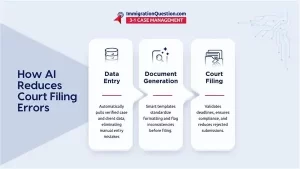
How AI-Based Document Automation Actually Helps
At its core, AI-based legal document automation is about replacing improvisation with structure. Instead of drafting every motion, petition, or notice from scratch, legal teams work from intelligent templates connected to a centralized database.
Case names, numbers, parties, and dates are pulled directly from verified records rather than retyped each time.
Standardization Without Rigidity
The word “standardized” sometimes makes lawyers uneasy, as if it implies cookie-cutter work. In practice, automation does the opposite.
It preserves consistency where courts demand it, such as captions, formatting, and required disclosures, while freeing attorneys to focus on the substance of their arguments.
The result is a filing that meets court expectations every time without draining hours of staff attention.
Built-In Error Detection
Modern court software solutions do more than assemble documents. They review them. Missing fields, mismatched data, and deadline conflicts are flagged before a filing ever leaves the office.
This kind of validation is especially valuable in high-volume practices where speed often competes with accuracy. Automation slows nothing down, but it quietly prevents the kinds of mistakes that humans overlook when rushing.
Efficiency That Supports Accuracy
One of the more surprising benefits of AI-driven court management software is that accuracy improves as work moves faster.
When documents can be generated in minutes rather than hours, teams no longer feel pressure to cut corners just to meet deadlines. Filing becomes a predictable process instead of a last-minute scramble.
This shift matters for morale as much as productivity. Paralegals spend less time double-checking boilerplate language. Attorneys review documents for legal substance rather than formatting quirks.
Clients experience smoother case progression without mysterious delays caused by rejected filings. In short, efficiency stops being the enemy of quality.
From Manual Processes to Managed Systems
Firms that adopt full court case management platforms often describe the change as less dramatic than expected. There is no sudden overhaul of legal judgment or strategy.
What changes is the background noise. Fewer frantic emails before midnight. Fewer apologies to clerks. Fewer quiet corrections that never make it onto a timesheet.
Court case software brings documents, deadlines, and data into one place, which makes errors easier to prevent and easier to trace when they do occur.
Audit trails and version control add accountability without adding bureaucracy. Everyone knows which version is current and why.
Why This Matters More Than Ever
Courts are increasingly digital, and tolerance for filing errors is shrinking. Electronic filing systems reject documents automatically, without sympathy for how close the deadline was or how minor the mistake seemed.
At the same time, clients expect efficiency, transparency, and predictability from their legal counsel.
AI-based legal document automation meets these expectations quietly and effectively. It does not replace legal expertise, but it supports it by removing avoidable risks from routine tasks. In a competitive legal environment, that reliability becomes a genuine advantage.
A Smarter Way Forward
Accuracy in court filings is not a luxury. It is a baseline requirement that consumes an outsized amount of time when handled manually.
Court software solutions allow firms to meet that requirement with less stress and greater consistency, while giving legal professionals more room to focus on the work that actually requires their judgment.
ImmigrationQuestion.com 3-1 Case Management brings AI-based document automation together with full court case management in a single, practical platform.
The goal is not to change how law is practiced, but to make sure preventable errors never stand in the way of good legal work.
Schedule a free demo to see how ImmigrationQuestion.com 3-1 Case Management can help your firm reduce filing errors, streamline workflows, and approach every court deadline with confidence.

Frequently Asked Questions
1. What Is AI-Based Legal Document Automation?
AI-based legal document automation uses software to generate court filings and legal documents from standardized templates, automatically pulling accurate case data and reducing manual input.
2. How Does Legal Document Automation Reduce Court Filing Errors?
It reduces errors by standardizing formatting, auto-filling verified case information, and flagging missing or inconsistent data before documents are submitted to the court.
3. Can Court Case Management Software Replace Manual Filing Processes?
Court case management software does not replace legal judgment, but it significantly reduces manual drafting, tracking, and review tasks that often lead to filing mistakes.
4. Is AI Legal Software Suitable for Small Law Firms?
Yes. AI-driven court software solutions are scalable and help small firms manage filings more accurately without adding staff or increasing administrative workload.
5. Does Court Software Help with Filing Deadlines?
Yes. Court management software tracks deadlines automatically and aligns them with court rules, reducing the risk of missed or miscalculated filing dates.