
Spreadsheets feel like the fastest way to get organized. They are familiar, flexible, and easy to share. But once a law firm starts juggling real client communication across multiple matters, a spreadsheet begins to show its limits. my are not static.
They move through calls, emails, meetings, document requests, reminders, and follow-ups. When that history is scattered, communication becomes harder to manage consistently.
That is why a CRM for lawyers works better than spreadsheets. A good CRM is built to track conversations over time, keep next steps visible, and help attorneys and paralegals stay aligned.
A law firm CRM is not just a contact list. It is a system that keeps the client’s story clear, so the firm can respond with context instead of guesswork.
Why Spreadsheets Start Breaking Down in Law Firms
A spreadsheet can store information, but it does not manage a relationship. In legal work, relationship management includes clarity, timing, and continuity. Here are the most common ways spreadsheets fall short.
1. Spreadsheets Do Not Preserve a Full Communication Timeline
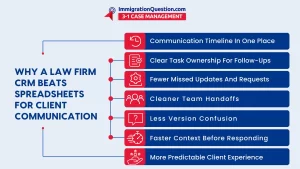
A spreadsheet might include a note like “called client” or “sent email,” but it rarely captures what matters later: what was discussed, what was requested, what the client confirmed, and what is due next. When those details live in email threads, sticky notes, or personal reminders, the team spends extra time reconstructing context.
This gets more noticeable when a client asks a simple question like, “Where are we on this?” If the person answering has to search multiple places before replying, the client experience starts to feel inconsistent, even if the legal work is strong.
2. Spreadsheets Rely on Memory for Follow-Ups
A cell can say “follow up on Friday,” but it will not reliably remind anyone. It also will not clarify who owns that follow-up. In busy practices, follow-ups that rely on memory slip first. This is common in busy practices. It is what happens when systems are not built around daily workflow.
CRM systems for law firms solve this by making follow-ups visible and trackable. Instead of hoping someone remembers, the task exists in the system, is attached to the client’s record, with ownership and timing.
3. Spreadsheets Make Team Handoffs Riskier
Law firms depend on teamwork. Matters get reassigned. Paralegals cover for each other. Attorneys step in when a case gets busy. In those moments, what the team needs most is a clean communication history and a clear next step.
Spreadsheets rarely provide that full picture. They often show fragments: a few dates, a few notes, a status label that can be interpreted differently by different people.
That can lead to repeated client requests, inconsistent updates, and internal back-and-forth that slows everything down.
What A Law Firm CRM Does Better Than A Spreadsheet
The advantage of a law firm CRM is not that it stores more data. It is that it organizes relationship work in a way that supports legal service.
1. It Centralizes Context, Not Just Contacts
A CRM for lawyers keeps client details, key notes, and interaction history together. That helps staff respond faster and with fewer errors. When a client calls, the person answering should be able to see what happened last, what is pending, and what the firm needs next, without hunting across tools.
2. It Turns Follow-Ups into a Routine, Not A Reminder
A CRM makes follow-ups part of the workflow. Tasks can be assigned, tracked, and reviewed. This is one of the biggest reasons CRM systems for law firms improve communication. It builds consistency into the system, instead of placing it on someone’s memory.
3. It Improves Continuity Across Attorneys and Paralegals
When communication is tied to the client’s record, handoffs become easier. A paralegal can step in and see the last update. An attorney can review prior requests without asking three people. A new team member can understand the matter faster. This is how firms reduce duplicated work and avoid mixed messages.
4. It Creates a More Predictable Client Experience
Clients usually value clarity. They want to know what is happening, what the firm needs from them, and what comes next. A CRM helps the firm communicate in a steady rhythm, because notes, tasks, and next steps are visible and structured.
What To Look for in CRM Systems for Law Firms
Not every CRM fits legal workflows. If the goal is better communication and cleaner follow-ups, these are the features that matter most.
1. Centralized Client Profiles That Are Easy to Scan
The CRM should make it simple to find key details quickly: contact info, related matter notes, communication history, and what is due next. If the system feels hard to navigate, adoption will suffer.
2. Intake That Reduces Duplicate Work
A strong CRM for lawyers reduces re-entry. Intake information should be carried forward to prevent the team from typing the same details into multiple places. Fewer re-entries mean fewer errors and fewer mismatched records.
3. Reminders And Task Ownership
Follow-ups should be assignable. Reminders should be tied to the client’s record. The team should be able to see overdue items quickly. If tasks exist but are hard to review, they will not be used consistently.
4. Notes That Support Handoffs
A simple internal standard helps: write notes that answer “what happened, what was decided, what is next.” Short, structured notes make it easier for another person to step in without confusion.
5. A Secure Way to Share Updates and Collect Documents
Many firms need a structured way to share updates and receive documents without long email chains. A secure client portal or client-facing channel can help communication stay organized, and expectations stay clear.
Where ImmigrationQuestion.com 3-in-1 Case Management Fits
Some firms use a standalone CRM. Others prefer one place where CRM and matter workflow stay connected, so communication does not drift away from the case record.
ImmigrationQuestion.com 3-in-1 Case Management is positioned as a centralized platform that supports organized client communication through a secure portal, reminders, workflow automation, and a unified view of case activity.
For CRM-focused teams, the value is continuity: client details, notes, communication history, and next steps stay connected in one workspace, which can make consistent updates and clean handoffs easier across attorneys and paralegals.
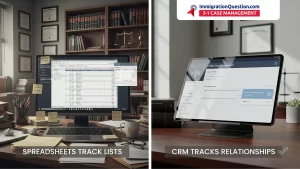
Spreadsheets can track lists. They cannot manage relationships. A CRM for lawyers works better because it keeps communication organized, makes follow-ups visible, and supports teamwork across a firm.
When a law firm CRM is used consistently, client communication becomes clearer and more predictable, without relying on memory or scattered notes.
For firms that want CRM and case progress to live in one connected workspace, ImmigrationQuestion.com 3-in-1 Case Management is one example of that approach.
Frequently Asked Questions
1) What Is A CRM For Lawyers?
A CRM for lawyers is a system that helps legal teams manage client relationships by organizing client information, tracking interactions, and supporting consistent follow-ups.
2) Why Do CRM Systems for Law Firms Work Better Than Spreadsheets?
CRM systems for law firms are designed to track communication history, assign follow-ups, and keep the next steps visible. Spreadsheets are static and typically rely on manual updates and memory.
3) What Features Matter Most in a Law Firm CRM?
Most firms prioritize centralized client profiles, communication tracking, reminders and task ownership, structured notes for handoffs, and a secure way to share updates or collect documents.
4) Can A Law Firm CRM Help Paralegals?
Yes. A law firm CRM can reduce time spent searching for context, improve follow-up tracking, and make handoffs smoother when multiple staff members work on the same matter.
5) How Does ImmigrationQuestion.com 3-in-1 Case Management Support CRM Work?
ImmigrationQuestion.com 3-in-1 Case Management supports CRM work by keeping client and matter information connected and providing tools for reminders, workflow steps, and client communication through a secure portal.