


Automation has transformed industries like finance, healthcare, and logistics. Yet in law, adoption remains cautious, uneven, and often reluctant. Despite the rise of AI-powered research tools, contract automation, and case management systems, many lawyers still hesitate to fully trust automation.
This hesitation is not irrational. In fact, it is deeply rooted in how the legal profession operates. But understanding why lawyers resist automation is the first step toward building technology they can actually trust.
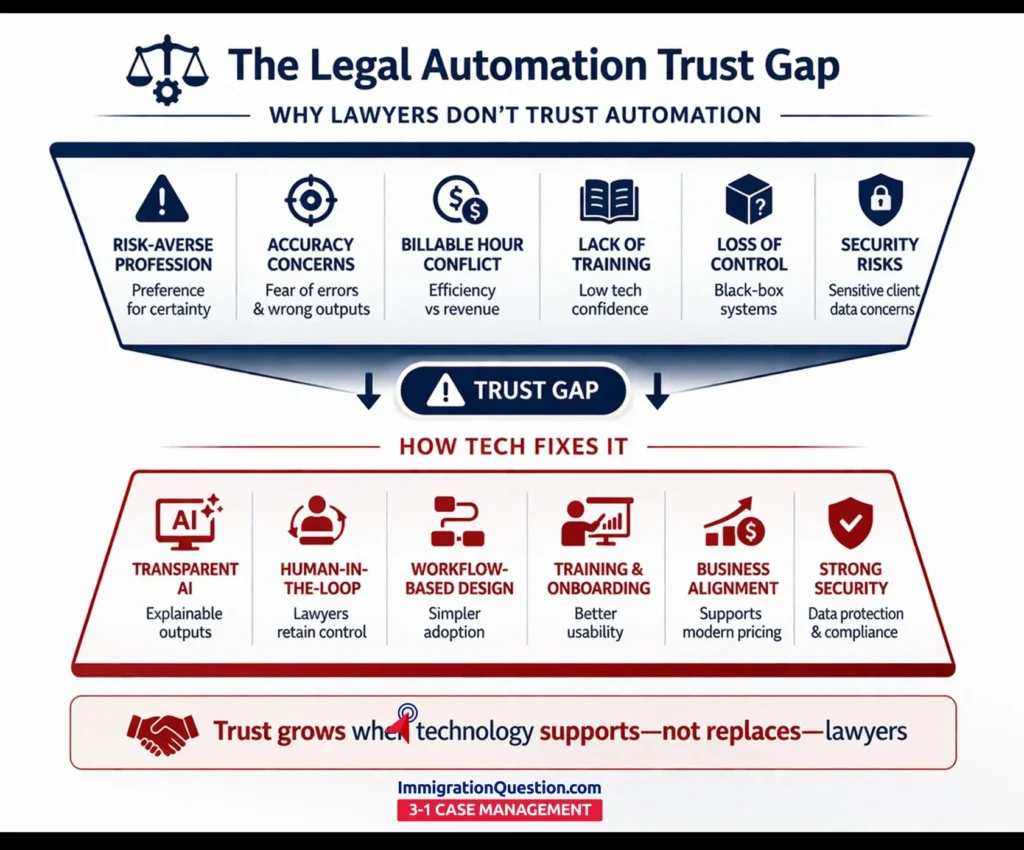
The Real Reason: Law Is Built on Risk Avoidance
Law is a profession trained to expect the worst-case scenario. Lawyers are taught to identify risks, anticipate failures, and protect against uncertainty.
Automation, especially AI-driven tools, introduces a layer of unpredictability. Unlike traditional legal processes, where every step is deliberate and traceable, automated systems can feel like a “black box.”
This creates an immediate conflict:
- Lawyers need certainty
- Automation often operates on probability
When even a small error can lead to malpractice, hesitation becomes a professional necessity, not resistance.
Accuracy Concerns Are Not Overblown
One of the biggest trust gaps comes from accuracy. Legal work demands precision, not approximation. Even minor inconsistencies in case law citations or contract language can have serious consequences.
Recent discussions in the legal industry highlight concerns about AI-generated errors, including fabricated citations and misleading outputs.
There is also what experts call the “verification burden.” Lawyers often spend additional time checking automated outputs, which can cancel out the efficiency gains.
So instead of saving time, automation can sometimes create more work.
The Billable Hour Problem
Another overlooked issue is economic, not technical.
Traditional law firms operate on billable hours. Efficiency, in this model, can actually reduce revenue.
This creates a paradox:
- Automation speeds up work
- Faster work can mean lower billing
As a result, lawyers may subconsciously resist tools that disrupt their financial model, even if those tools improve productivity.
However, this is slowly changing as more firms move toward fixed fees and value-based pricing.
Lack of Training and Tech Literacy
Most lawyers are not trained in technology. Legal education still focuses heavily on doctrine, case law, and argumentation, with minimal emphasis on digital tools.
This creates a gap:
- Tools are evolving rapidly
- Users are not
Without proper training, even the best software feels intimidating or unreliable. According to industry insights, lack of technical understanding is a major barrier to adoption.
It is not that lawyers reject automation. They simply do not feel confident using it.
Fear of Losing Control
Automation shifts control from the individual to the system. For a profession that values autonomy and judgment, this can feel uncomfortable.
Many lawyers worry about:
- Not fully understanding how decisions are generated
- Losing visibility into critical processes
- Over-reliance on tools they cannot explain
This is especially important in court, where accountability cannot be delegated to software.
As one recurring theme in legal tech discussions suggests, lawyers prefer tools that assist rather than replace their thinking.
Security and Confidentiality Risks
Law firms handle highly sensitive data, from corporate secrets to personal client information. Any technology that processes this data must meet extremely high security standards.
Data privacy remains one of the biggest concerns slowing adoption.
A single breach can damage reputation, violate client trust, and lead to legal consequences. Until tools can guarantee enterprise-grade security, skepticism will remain.
The Human Problem Behind “Tech Failure”
Interestingly, many legal tech failures are not caused by bad technology but by poor implementation.
Experts point out that adoption often fails due to:
- Lack of planning
- Resistance to change
- Poor onboarding processes
In other words, the issue is not automation itself, but how it is introduced into the workflow.
This is a critical insight: solving the trust problem requires solving the human problem.
How Tech Can Actually Fix the Trust Gap
If distrust is the problem, then better design, better strategy, and better positioning are the solution.
1. Make Automation Transparent
Lawyers do not trust what they cannot see.
Tools must move away from “black box AI” and toward:
- Clear explanations of outputs
- Traceable sources and citations
- Step-by-step reasoning
Transparency builds confidence and reduces the fear of hidden errors.
2. Keep Humans in the Loop
The goal of legal tech should not be replacement. It should be augmentation.
The most successful tools:
- Automate repetitive tasks
- Leave final judgment to lawyers
This hybrid model aligns with how lawyers already work and think.
3. Focus on Workflow, Not Just Features
Many legal tech products fail because they try to impress with features instead of solving real problems.
Lawyers value:
- Simplicity
- Reliability
- Seamless integration into existing workflows
Technology that reduces friction will always outperform technology that adds complexity.
4. Invest in Training and Adoption
Even the best software fails without proper onboarding.
Firms need to:
- Train lawyers continuously
- Create internal champions
- Normalize tech usage across teams
Adoption is not a one-time event. It is a cultural shift.
5. Align with Business Models
Automation works best when it aligns with how firms make money.
As the industry shifts toward fixed fees and client-centric pricing, automation becomes a competitive advantage rather than a threat.
Forward-thinking firms are already using automation to:
- Deliver faster results
- Reduce operational costs
- Improve client satisfaction
6. Prioritize Security and Compliance
Trust cannot exist without security.
Legal tech providers must:
- Meet strict data protection standards
- Offer compliance certifications
- Provide clear data handling policies
When security is visible and verifiable, adoption becomes easier.
The Future Isn’t Automation vs Lawyers
The real future of legal tech is not about replacing lawyers. It is about redefining their role.
Automation will handle:
- Repetitive tasks
- Document processing
- Initial research
Lawyers will focus on:
- Strategy
- advocacy
- complex decision-making
Firms that understand this balance will not just survive the shift. They will lead it.
Turn Automation into Your Competitive Advantage
The trust gap in legal automation is real, but it is not permanent. The right tools, combined with the right approach, can turn skepticism into confidence and hesitation into growth.
If you’re looking for a smarter way to integrate automation into your legal practice, explore ImmigrationQuestion.com 3-in-1 Case Management.

Frequently Asked Questions
Why are lawyers resistant to automation?
Lawyers are trained to minimize risk and prioritize accuracy. Automation introduces uncertainty, which conflicts with this mindset.
Is legal automation reliable enough for real cases?
It can be, but only when combined with human oversight. Fully relying on automation without verification is risky.
Does automation reduce billable hours?
Yes, in traditional models. However, it can increase profitability under fixed-fee or value-based pricing structures.
What is the biggest barrier to legal tech adoption?
The biggest barrier is not technology itself but human factors like resistance to change and lack of training.
How can law firms build trust in automation?
By using transparent tools, maintaining human oversight, investing in training, and ensuring strong data security.