

A client emails your office with a link to a breaking USCIS announcement and asks if it impacts their pending adjustment of status case. Before you’ve had time to read the update, another client calls with the same question about a different case. By midday, your inbox contains several messages about a policy that only became public a few hours earlier.
Situations like this are common in immigration practice. Policy memoranda, court decisions, agency guidance, and procedural changes can influence active cases with little notice; now the challenge is knowing what developments require immediate attention and which clients they affect.
This blog explains how immigration attorneys can respond to policy changes without disrupting their operations and what a policy-ready practice looks like in 2026.
Why Immigration Policy Changes Are Challenging to Manage
Lots of immigration attorneys have newsletter subscriptions, monitor agency announcements, or belong to professional organizations that share legal developments; however, it can be challenging to scan through materials from multiple sources.
Imagine you are having a busy day, with client meetings, filing deadlines, court appearances, and documents waiting for review when you get a new update. Reading the announcement is only the first step. You must also decide whether it changes the way you handle any active matter.
That decision becomes harder when client information is spread across websites, emails, and alerts.
How to Identify Which Active Cases Are Affected by a Policy Change
Once you understand the new guidance, another set of questions follows.
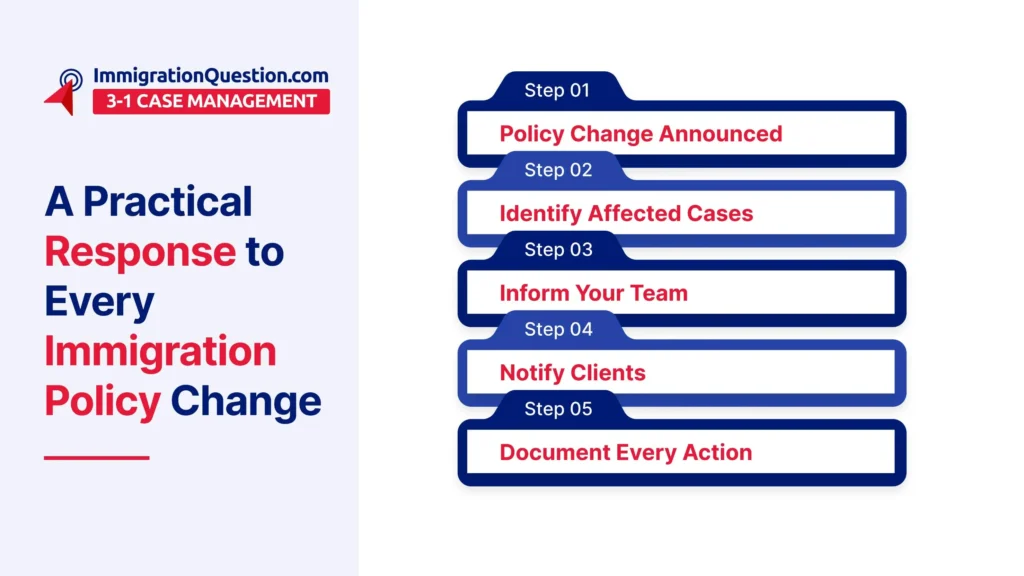
- Which active cases are affected?
- Which clients should hear from you first?
- Does any filing need to be revised?
- Has anyone on your team already started preparing a case under the previous guidance?
- Should future consultations be handled differently?
Finding those answers quickly depends on how your practice is organized.
A legal policy change may affect only a portion of your workload, yet identifying the files manually could consume hours that should be spent doing legal work. For instance, preparing for a court hearing should be your priority if you are managing employment petitions across industries and USCIS updates its adjudication approach for specialty occupation cases.
Information Becomes Useful when it Connects to Active Matters
Suppose a Board of Immigration Appeals decision changes the interpretation of an issue that appears in several pending asylum matters. The decision itself may take only a few minutes to read, but determining which clients require immediate attention usually takes much longer if files are scattered across different folders, spreadsheets, or databases.
A policy-ready practice allows you to answer one important question without unnecessary searching: “Which matters require my attention today?”
Once those files are identified, legal analysis becomes swift.
How Immigration Law Firms can Respond to Policy Changes More Efficiently
Reception staff may need updated appointment guidance. Paralegals preparing petitions should know whether document requirements have changed. Associate attorneys should apply the same interpretation across similar matters. Everyone involved in case preparation should work from the same current information.
Without a shared process, employees may unknowingly prepare similar cases using different standards. This increases the risk of errors and complaints about inconsistent client service.
Keeping the entire office aligned becomes easier when policy information is available where the work is already taking place instead of relying on external mediums.
How to Keep Clients Informed When Immigration Policies Change
Policy announcements travel quickly. Clients now receive immigration news through social media, online forums, news websites, and community groups within minutes of publication. When a change is announced, clients naturally want to know whether their own case has been affected and how. A prompt response reassures them that their matter is receiving the needed attention and prevents feelings of uncertainty.
A proper communication system also keeps record of when information was shared and what advice was provided. That record becomes valuable if questions arise later about how the matter was handled. The goal is not to respond to every immigration headline, but to recognize which developments affect your clients and communicate them as quickly as is necessary.
Turn Policy Changes into Informed Decisions with ImmigrationQuestion.com 3-in-1 Case Management Software
As immigration legal practice continues to evolve, an efficient and organized case management system makes it easier to keep track of updates.
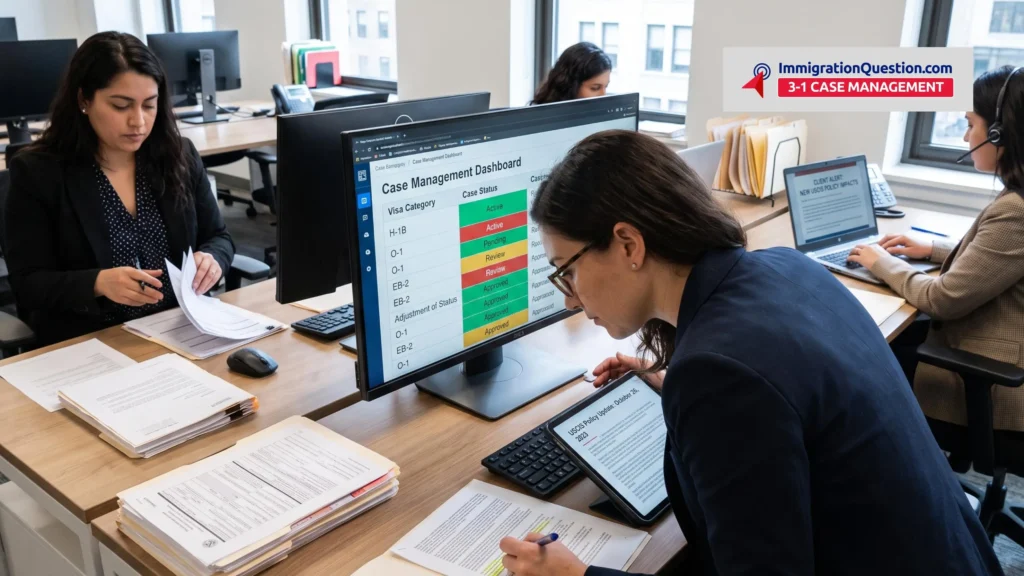
The ImmigrationQuestion.com 3-in-1 Case Management Software eases the process of a case by offering policy updates, case management, virtual staffing solutions, and social media visibility in a single platform. Attorneys can review immigration news without leaving their workspace, organize matters by visa category and case status, identify files that may require attention, document client communication, and maintain complete case records in one place.
Ready to give it a trial? Schedule a demo now.
Frequently asked questions
Is staying informed about immigration policy changes part of an attorney’s professional responsibility?
Yes. Attorneys have a duty to maintain competence, which includes keeping track of legal developments and understanding their impact on each matter.
Why do policy changes create challenges for busy immigration practices?
The challenge is identifying which active matters require immediate attention and which ones don’t.
What should an attorney do after a policy change is announced?
Review the update, determine whether active matters are affected, evaluate whether legal strategy or documentation requires adjustment, and communicate with affected clients where appropriate.
Why is case organization important when immigration policies change?
Organized case records make it easier to identify which matters may be influenced by new guidance without having to review every case file.
How does documenting client communication help an immigration practice?
Documented communication provides a record of when clients receive updates and what information is shared throughout the life cycle of a case.