
Never allow your immigration law firm to reach a point where the unavailability of a team member could affect the steady operation of your firm. Do not let your daily operations rely significantly on a specific individual and less on the systems that support the work. Firms that organize information, document procedures, and establish consistent workflows are more likely to continue serving clients without needless disruption, even when a core team member is absent.
Staff absences happen for different reasons. Annual leave, illness, professional development, parental leave, or an unexpected resignation can all affect the daily rhythm of a practice. Client cases do not pause when such situations arise; hence, business continuity planning is a vital aspect of immigration law firm management.
This blog examines practical ways immigration law firms can strengthen business continuity through documented workflows, accessible information, and systems that support consistent operations every day.
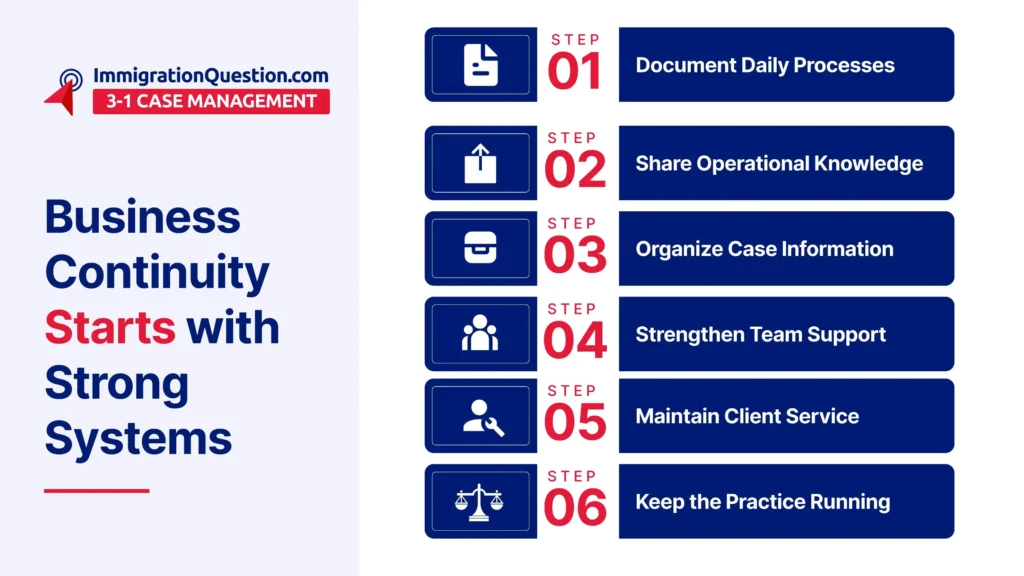
Why Every Immigration Law Firm Needs Business Continuity Planning
Business continuity planning means keeping essential functions running when unexpected changes affect the practice. For immigration law firms, responsibilities include client communication, document preparation, scheduling, case management, and meeting filing deadlines.
A continuity plan maintains the client experience. Attorneys and support staff can continue answering inquiries, preparing cases, and managing deadlines because responsibilities have been fixed. That preparation reduces uncertainty across the firm and guarantees clients the progress of their matter.
Identify Responsibilities that Depend on One Person
Every firm has responsibilities that gradually become associated with each employee. One person schedules consultations, another prepares National Visa Center documents, while someone else manages bookkeeping, client follow-ups, or document requests. Those arrangements may work well until that individual is absent.
An internal review helps to identify where knowledge has become concentrated. Once those responsibilities are visible, firms can begin creating practical ways for other team members to understand the process, access key information, and continue the work without lagging.
The goal is not to replace individual expertise. The purpose is to ensure the practice does not depend entirely on a single person to keep daily operations running.
Document the Processes Your Team Uses Every Day
Clear documentation creates uniformity throughout the firm. Every recurring responsibility ought to follow a process that another team member can understand without relying on another’s physical presence.
Client Intake Procedures
Consultation scheduling, intake forms, onboarding steps, and document requests ought to follow a consistent structure. A documented process guarantees every prospective client receives the same level of service, regardless of who handles the interaction.
Case Management Procedures
Case files, supporting documents, communication records, and government forms benefit from standardized organizations. Uniform naming methods, file locations, and case updates allow attorneys and staff to locate information quickly whenever they need it.
Administrative Procedures
Billing activities, appointment scheduling, follow-up communication, and internal reporting become easier to manage when each task follows an established process. Documented procedures also make training more efficient as the practice grows.
Keep Information Accessible Across the Practice
Information becomes valuable only when the right people can access it at the right time. Case updates, communication history, client documents, appointment records, and supporting evidence should remain organized within a shared system rather than scattered across individual computers, notebooks, or email folders.
A centralized approach lets attorneys and staff to continue working confidently when responsibilities shift from one person to another. Questions receive quick answers because the information already exists in a single system rather than relying on a staff member’s availability.
Organized records also strengthen collaboration. Each team member works with the same information, reducing ambiguity and supporting better decisions throughout the life of every immigration case.
Build Support Around the Practice, not One Individual
Strong systems become even more effective when supported by the right people. Administrative responsibilities continue when attorneys are preparing petitions, attending hearings, or meeting with clients, making dedicated operational support an important part of business continuity.
Client communication, consultation scheduling, bookkeeping, document preparation, and National Visa Center case support are examples of responsibilities that benefit from specialized assistance. Distributing those tasks across qualified professionals creates a stronger operational foundation while allowing attorneys to devote more attention to legal representation.
A practice supported by well-defined roles is better prepared to respond when workloads change or staffing needs evolve.
Prepare Today for the Moments You Can’t Predict
No law firm can predict every staffing change, yet every practice can prepare for it. Business continuity begins with documented procedures, organized information, shared responsibilities, and systems that allow work to continue without interruption. Those decisions strengthen daily operations while creating a more consistent experience for both clients and staff.
Strong business continuity requires systems that continue to work when responsibilities change. ImmigrationQuestion.com 3-in-1 Immigration Case Management Software combines case management, staffing solutions, and social media visibility with free leads, supported by secure document storage, auto-filled USCIS forms, customizable forms, real-time case progress. You can also access highly-trained virtual staff, including Receptionists, NVC Specialists, Bookkeepers, and Business Development Executives. Together, these resources help immigration law firms maintain continuity while satisfying clients without interruption. Schedule a free demo today.

Frequently Asked Questions
- What is law firm business continuity?
Law firm business continuity is the process of preparing systems, procedures, and responsibilities so legal services can continue without major disruption when staffing or operational changes occur.
- Why should immigration law firms prepare for staff absences?
Preparation helps protect client service, maintain organized workflows, support communication, and reduce disruption when a team member is unavailable.
- Why is documenting internal processes important?
Documented procedures create consistency, simplify training, improve collaboration, and allow responsibilities to move smoothly between team members when needed.
- How do case management systems support business continuity?
Case management systems keep case records, client communications, documents, and other important information organized, allowing authorized team members to continue working without relying on a single individual’s knowledge.
- What responsibilities should be included in a business continuity plan?
Client intake, document management, scheduling, communication, billing, case preparation, and administrative workflows should all form part of a continuity plan.
- How can staffing solutions strengthen business continuity?
Dedicated operational support helps firms maintain client communication, handle administrative responsibilities, manage bookkeeping, and prepare cases while attorneys focus on legal work.