


An immigration attorney may have a website, social media pages, a strong professional profile, and many years of experience, yet still wonder why the number of cases coming in does not reflect this. The problem may be poor online visibility.
A recent report shows 86% of law firms have a social media presence; 71% of lawyers said social media helped them generate new leads, and 65% of law firms said their website gave the highest return on investment. These figures show how important online visibility has become.
As an attorney in 2026, you need to ask yourself this question: Can clients find you online?
This blog focuses on how immigration attorneys can use online search queries to create targeted content, improve their visibility across platforms, and attract prospective clients whose needs align with the services they provide.
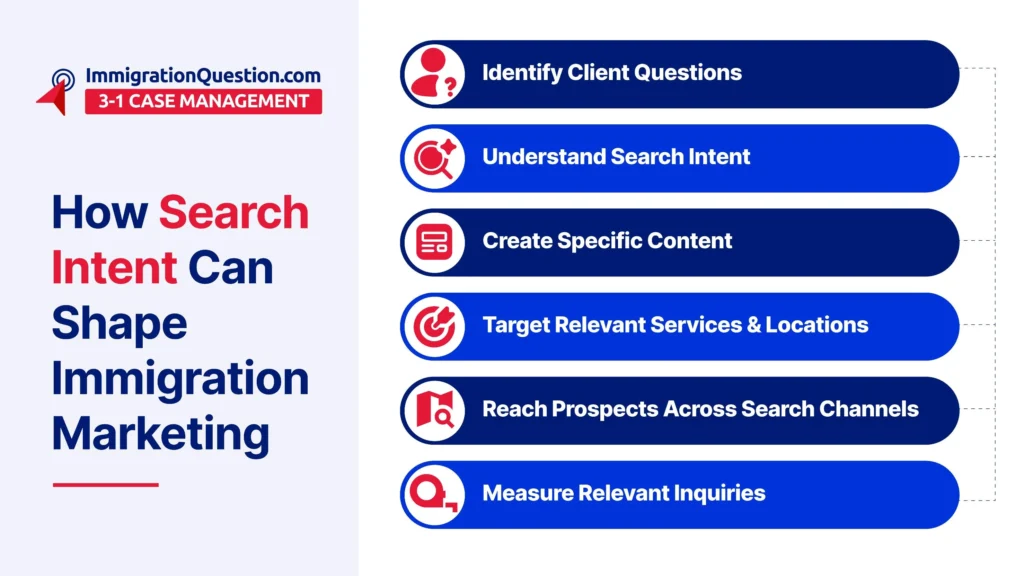
How Search Intent Helps Immigration Attorneys Find Relevant Clients
Search intent refers to the reason behind a person’s search and the answer they hope to find. Before contacting an immigration attorney, a prospect has probably spent hours searching for information about a specific situation they hope to solve.
For example, a search query might say: “What is the next procedure after my family petition approval?”
For an immigration practice, the phrase used in that search can reveal where the person is in their decision process. Someone researching a general immigration concept may need basic information, while a person searching for advice related to their case may be considering professional assistance.
The distinction here can shape what an attorney publishes. Rather than relying on broad terms, a practice can identify questions specific to its services, case types, and the issues its clients usually encounter.
The result is content that speaks to a person’s concern at a given time, which gives the attorney a better opportunity to reach prospective clients whose needs align with their practice.
How Immigration Attorneys Can Turn Client Questions into Content
Think about the consultation that begins with, “My petition was approved, so what happens now?” Or the prospective client who asks whether an old removal order could affect a future immigration application. An attorney can turn these recurring questions into educational pages, articles, videos, or frequently asked questions that provide guidance.
The content should also have a clear purpose, like explaining specific immigration processes or giving general advice about immigration cases. That distinction becomes helpful when people post highly personal questions online.
For an immigration practice, useful content should address specific immigration questions with practical information, then invite prospects to seek individual consultation with an attorney who can assess their unique situation.
How SEO, AEO, and GEO Help Immigration Attorneys Reach the Right Audience
Search engine optimization (SEO) remains important, while answer engine optimization (AEO) and generative engine optimization (GEO) are becoming part of how legal information is discovered in 2026. The American Bar Association’s 2026 discussion of AI-powered search, based on research with Near Media, found that 54% of respondents used Google or another search engine to learn about legal issues, while 13% used an artificial intelligence tool or chatbot. Fewer than 2% said they would use AI to find a lawyer.
For immigration attorneys, the broader opportunity is to make useful, specific content available wherever prospective clients search for information, including search engines, legal directories, professional profiles, social platforms, and discussion forums. AI-generated answers can form part of that information environment, but the focus should remain on creating content that clearly addresses the questions prospective clients are already asking.
What Immigration Attorneys Should Measure Beyond Website Traffic
Website visits tell an attorney that people arrived.
A stronger review of marketing activity can ask:
- Which searches led people to the website?
- Which practice areas generate more inquiries?
- Which pages are people reading before contacting the firm?
- How did new clients say they found the attorney?
- Are inquiries connected to the firm’s preferred case types and locations?
Those details give an attorney a clearer picture of whether marketing activity is leading to conversions rather than simply increasing website traffic.
Turning Online Visibility into a Strong Client Acquisition Process
Search intent gives immigration attorneys a practical way to think about marketing from the client’s or prospect’s perspective. The process begins with the problem they need a solution for, then the information they search for, and continues through the content and online presence that leads them to an attorney.
The ImmigrationQuestion.com 3-in-1 Case Management Software brings policy updates, case management, virtual staffing solutions, and social media visibility all together on a single platform. Attorneys can review immigration developments without leaving their workspace, organize matters by category and status, document client communication, maintain case records, and keep daily operations moving through one connected system. To explore this, schedule a demo now.
Frequently Asked Questions
- How can immigration attorneys use search intent to attract clients?
Attorneys can identify questions relating to their practice areas and create useful content that addresses those questions with Call to Actions (CTAs) for readers to engage with the firm.
- What keywords should immigration attorneys target?
Keywords should reflect the services, case types, locations, and client problems the practice handles rather than relying only on broad terms.
- How is SEO different from search intent?
SEO concerns how content is discovered in search engines. Search intent concerns why someone is searching and what they are trying to find.
- Does AI-powered search affect immigration attorney marketing?
Yes. AI-powered search introduces a new way to discover legal information, although current research indicates that traditional search engines remain a more common source for researching legal issues.
- How can an immigration law firm tell whether its marketing is attracting the right clients?
The firm can review inquiry sources, search queries, relevant practice areas, website user behaviors, and client attribution information. An assessment of this combination of data can be used to draw business insights.