

An immigration attorney can ask an AI tool to summarize a lengthy document, prepare a first draft, or organize data. That speed creates a useful opportunity: less time spent on repetitive tasks and more time available for work that requires legal judgment. It’s essential to identify which tasks AI can take off your daily workload and where your involvement remains necessary.
This article covers how immigration attorneys can use AI for legal work while recognizing that human judgment and review remain indispensable.
How to Measure the Time AI Saves
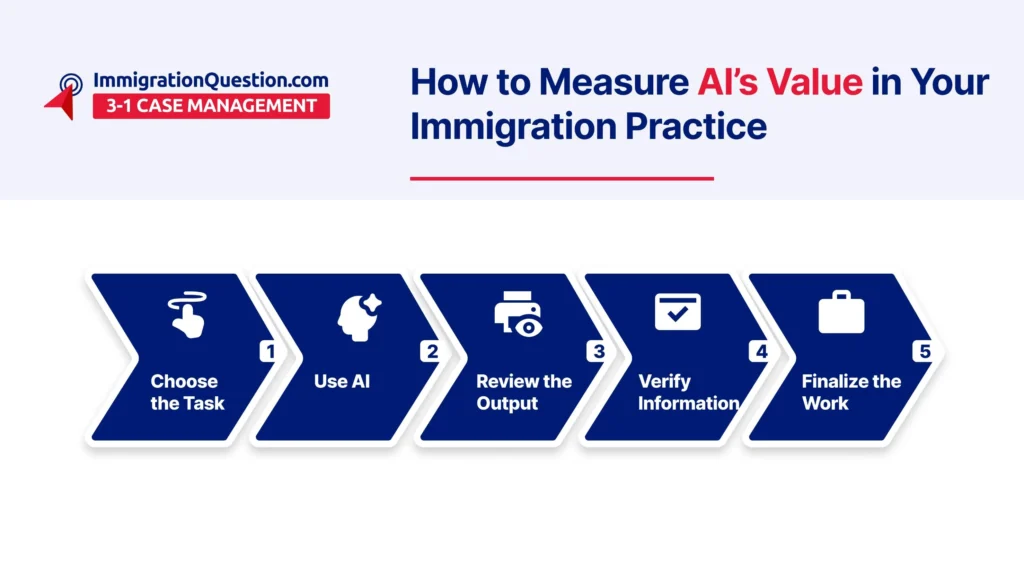
Suppose a document took an hour to prepare manually. AI produces a first draft in less than a minute, then the attorney then spends twenty minutes reviewing it, correcting information, checking sources, and preparing the final version. The relevant figure is the time required to complete the entire task.
A practical comparison includes:
- Time spent preparing the work without AI.
- Time spent producing the AI-assisted output.
- Time spent reviewing and correcting the output.
- Time spent checking information against reliable sources.
- Time spent preparing the final version.
Attorney discussions about AI productivity show why this comparison matters. Some lawyers report significant gains from using AI for routine work, while others complain about spending substantial time reviewing and editing generated material.
AI productivity should be measured by the total time required to produce a high-quality output.
Which Immigration Tasks Can AI Handle Efficiently?
AI tools can assist immigration attorneys with tasks that involve organizing data, preparing drafts, and handling repetitive work.
The tasks AI can assist with include:
- Summarizing lengthy documents.
- Organizing information from notes.
- Preparing preliminary outlines.
- Drafting routine correspondence.
- Creating initial question lists.
- Converting rough notes into organized information.
The type of matter also affects the usefulness of the tool. A straightforward document summary may require limited correction. A complicated immigration history may contain dates, prior applications, status changes, or procedural events that require human handling.
The most effective use of AI is to assign it supportive tasks that advance the attorney’s workflow while reserving final judgment for the attorney.
AI-Assisted Work Requires Attorney Judgment
Immigration matters depend on facts that require individual assessment.
An attorney may need to consider prior applications, immigration history, conflicting records, procedural developments, and available options. AI can organize documents and assist with preparation, but the attorney determines how those facts apply to the matter.
A recent court incident demonstrates the importance of that distinction. An attorney submitted AI-generated legal citations that included authorities that did not exist. The matter reached the Connecticut Supreme Court, which issued a warning about the risks of relying on AI-generated legal material without checking its accuracy.
The same principle applies to immigration work. A polished AI response can contain an incorrect fact, omit an important detail, or apply general information to circumstances that require individual analysis.
Attorney review is highly essential for legal analysis, case strategy, filing, client communication, and documentation submitted to a government agency.
Use AI Where It Adds Value to Your Practice
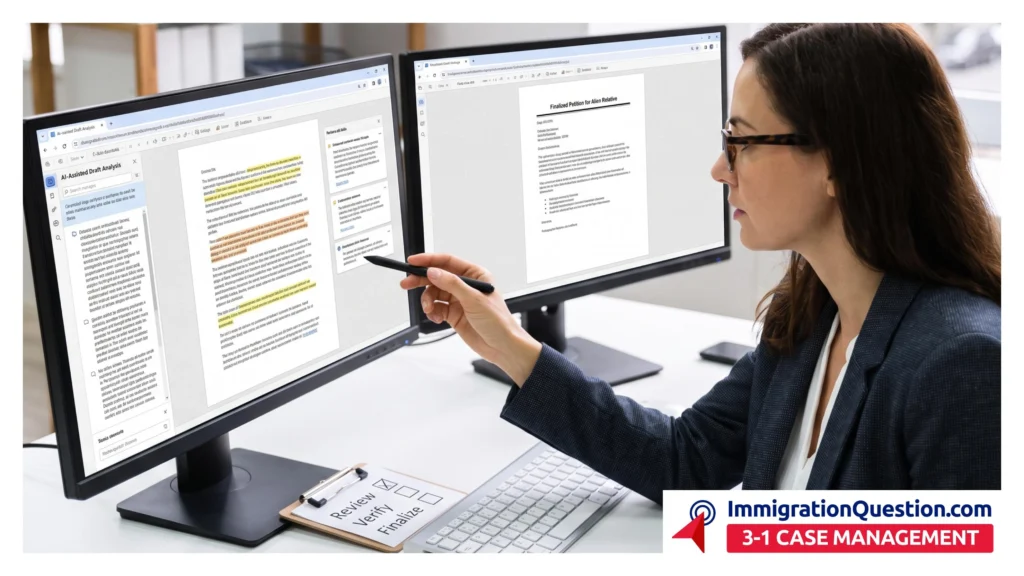
AI can become a useful part of an immigration practice when its role is limited, and its output is closely monitored and reviewed.
Begin with repetitive tasks and data organization. Measure the time required to complete those tasks, assess the quality of the output, and establish the point at which attorney review is required.
That approach allows you to enjoy the benefits of AI without treating the technology as a substitute for professional judgment.
ImmigrationQuestion.com 3-in-1 Case Management Software provides operational work support for case records, document storage, communication records, policy updates, and virtual staffing solutions. These tools can give attorneys more time for work that requires their direct involvement.
See how the platform can support your practice. Schedule a demo now.
Frequently Asked Questions
- Can AI save an immigration attorney’s time?
Yes. AI can reduce time spent on tasks such as document summaries, data organization, preliminary drafting, and routine correspondence.
- What AI tools can immigration attorneys use?
Attorneys can use AI tools for document analysis, drafting, summarization, data organization, research, and other routine tasks.
- How can an immigration attorney measure AI productivity?
Compare the total time required to complete a task, including research, first drafts, review, correction, verification, and finalization.
- Should attorneys review AI-generated legal work?
Yes. Attorney review is important for work involving case-specific facts, legal analysis, professional judgment, filings, and communications involving a legal matter.
- How can AI support immigration law practice?
AI can assist with repetitive tasks and data organization, giving attorneys more time for tasks that require their professional judgment.